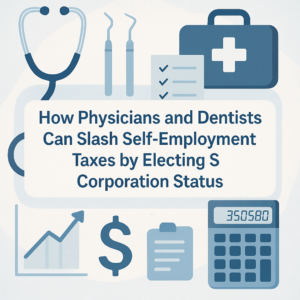
How Physicians and Dentists Can Slash Self-Employment Taxes by Electing S Corporation Status
Self-employed healthcare professionals, whether you’re a dentist in private practice, a physician running a solo clinic, or an allied health practitioner building your own brand, face a heavy self-employment tax burden. With Social Security and Medicare taxes totaling 15.3% on net earnings, the impact on your take-home pay can be significant. Electing S Corporation status for your practice can reduce that tax load and help you keep more of your hard-earned income.
In this comprehensive guide, we’ll walk through everything you need to know, from the basics of self-employment taxes to a step-by-step roadmap for converting your practice to an S Corp. We’ll also provide best practices for bookkeeping, payroll setup, and IRS filings, plus a real-world example of how an S Corp election can translate into thousands of dollars in annual savings for doctors and dentists. Ready to optimize your tax strategy? Let’s dive in.
Table of Contents
1. Understanding Self-Employment Taxes
Self-employment tax covers both the employer and employee portions of Social Security (12.4%) and Medicare (2.9%), totaling 15.3%. As a self-employed physician or dentist, you’re responsible for paying the full amount on your net practice profits. Here’s how it breaks down:
- Social Security Tax (12.4%) applies on net earnings up to the annual wage base limit (for 2025, $176,100).
- Medicare Tax (2.9%) applies on all net earnings, with an additional 0.9% surtax for incomes above $200,000 (single) or $250,000 (married filing jointly).
Example: If your net practice income is $200,000, you owe roughly $30,600 in self-employment tax alone (15.3% of $200,000). By contrast, as an S Corp, only your salary is subject to payroll taxes; distributions avoid the employer/employee rate, saving you 15.3% on that portion.
2. What Is an S Corporation?
An S corporation is a special tax election available to eligible corporations and LLCs. By filing IRS Form 2553, your practice can be taxed as an S Corp. Key characteristics include:
- Pass-through taxation: profits and losses flow through to your personal return (Form 1040), avoiding double taxation.
- Reasonable salary requirement: owners must pay themselves a market-based salary, subject to payroll taxes.
- Owner distributions: shareholders receive distributions not subject to self-employment or payroll taxes, reducing overall tax liability.
Not every healthcare practice is suited for S Corp status. You must weigh administrative complexity, state rules, and the need for diligent payroll compliance before electing.
3. Key Benefits for Healthcare Professionals
Electing S Corp status can yield significant advantages for doctors, dentists, and allied health practitioners who meet eligibility requirements:
- Self-Employment Tax Savings: Only W-2 salary is subject to FICA; distributions are exempt from the 15.3% Self-Employment Tax.
- Income Flexibility: Optimize the ratio of salary vs. distribution to balance tax savings with retirement plan contributions.
- Retirement Plan Opportunities: Contribute to a 401(k) or SEP IRA based on salary, potentially boosting deductible retirement savings.
- Professional Credibility: Operating as a corporation can enhance perceived professionalism with vendors, insurers, and patients.
On average, physicians and dentists might see an annual tax savings ranging from $5,000 to $25,000 (depending on income levels and reasonable salary benchmarks).
4. Eligibility & Considerations
Before proceeding, ensure your practice meets these criteria:
- Entity type: You operate as an LLC or C corporation (to elect S Corp status).
- Domestic business: All shareholders must be U.S. citizens or residents.
- Single class of stock: You cannot issue preferred stock or special allocations.
- Reasonable compensation: You can set and document a fair market salary for your role.
- State compliance: Some states impose fees, franchise taxes, or disallow S Corp elections – confirm local regulations.
If you’re a solo practitioner or part of a small group, an S Corp election often makes sense. Larger group practices may instead consider professional corporation (PC) structures with similar benefits.
5. Step-by-Step Conversion Process
Step 1: Entity Evaluation & Agreement Update
Begin by reviewing your existing entity documents. If you practice as an LLC, confirm that your operating agreement allows for an S Corp election. If necessary, amend your agreement to include all owners/shareholders and designate equity interests.
Step 2: QuickBooks & Bookkeeping Setup
Accurate accounting is critical. Use QuickBooks (or your preferred bookkeeping software) to establish separate accounts for payroll, distributions, and operating expenses. Engage an advisor or CPA to configure:
- Chart of accounts aligned with S Corp requirements.
- Payroll vendor integration for W-2 processing.
- Automated reports to track salaries vs. distributions.
Step 3: File IRS Form 2553
Complete and submit Form 2553 no later than two months and 15 days after the beginning of the tax year you want the election to take effect. Key fields include:
- Election date and effective tax year.
- Shareholder signatures and consent.
- Reasonable compensation method description.
Your CPA can handle filing; confirm mailing addresses and timely submission to avoid defaulting back to sole proprietor status.
Step 4: Establish Reasonable Salary
The IRS requires S Corp owners to receive “reasonable compensation” for services rendered. To determine a fair salary:
- Research market rates for your specialty and region.
- Document your time allocation between clinical, administrative, and management duties.
- Maintain payroll records: including pay stubs, quarterly filings (Form 941), and W-2 issuance.
Any net profits above your W-2 salary can then be distributed as shareholder distributions, free from Medicare and Social Security payroll taxes.
Step 5: Quarterly Payroll & Estimated Tax Payments
- Run payroll at least monthly for yourself and any staff.
- Deposit payroll taxes (federal and state) on schedule using the Electronic Federal Tax Payment System (EFTPS).
- Continue making quarterly estimated tax payments on distributions and other non-wage income.
Staying current on payroll and estimated taxes prevents underpayment penalties and interest.
Step 6: Annual Compliance & Reporting
- File Form 1120-S (U.S. Income Tax Return for an S Corporation) by March 15 (or extension).
- Provide each shareholder with Schedule K-1 reflecting their share of profits, deductions, and credits.
- Maintain corporate minutes for elections, distributions, and shareholder meetings.
Work with your CPA to calendar deadlines and ensure state-level filings (annual reports, franchise taxes) are satisfied.
6. Tax-Savings Example
Dr. Smith is a solo dentist in Florida. Her net practice income is $180,000 annually. Prior to S Corp election, she paid:
- Self-Employment Tax (15.3% on $180,000): $27,540
- Federal & State Income Tax (assume 24%): $43,200
- Total Tax Burden: $70,740
After converting to an S Corp:
- Reasonable Salary: $100,000 → Payroll tax (15.3%): $15,300
- Owner Distribution: $80,000 → No payroll tax
- Federal & State Income Tax (24% on $180,000): $43,200
- Total Tax Burden: $58,500
Annual Tax Savings: $12,240 (17% reduction in combined burden). Even after accounting for payroll service fees and additional bookkeeping, Dr. Smith nets over $10,000 more per year.
7. Bookkeeping & Payroll Best Practices
- Segregate Accounts: Maintain dedicated bank accounts for payroll and distributions to avoid commingling.
- Document Everything: Keep copies of corporate minutes, election consents, and payroll reports.
- Engage Professionals: Partner with a CPA experienced in healthcare S Corps and a payroll provider familiar with medical practices.
- Review Quarterly: Compare actual distributions vs. planned; adjust salary on an annual basis to remain reasonable.
- Automate Where Possible: Use integrated software for bookkeeping, payroll, and tax filings to reduce manual errors.
Following these guidelines will ensure your S Corp structure remains compliant and continues to deliver tax-efficient results.
8. Next Steps & How We Can Help
Ready to explore an S Corp election for your healthcare practice? Here’s how to move forward:
- Schedule a complimentary strategy call: Book Now
- Learn about our process and team: Our Process | About Us
At Mainstay Capital, we specialize in financial planning for physicians, dentists, and other healthcare professionals. Our customized approach helps you reduce your tax burden, strengthen retirement planning, and build lasting wealth.
9. Disclaimer
This blog post is for educational purposes only and does not constitute tax or legal advice. Please consult a qualified CPA or attorney before making any entity election or tax-planning decision. Past savings examples do not guarantee future results. Mainstay Capital is a Registered Investment Advisor; see our About Us page for full disclosures.