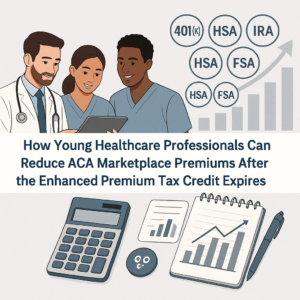
How Young Healthcare Professionals Can Reduce ACA Marketplace Premiums Now That Enhanced Credits Have Expired
The Affordable Care Act’s Premium Tax Credit (PTC) has been a lifeline for many early-career physicians, dentists, residents, and other healthcare workers purchasing individual coverage on the Marketplace. From 2021 through 2025, Congress temporarily enhanced the PTC to cap premiums at a lower percentage of income and broaden eligibility. That enhancement expired on December 31, 2025, meaning premiums in 2026 will spike for those above 400% of the Federal Poverty Level (FPL).
For busy young professionals, higher costs can strain tight budgets already stretched by student loans, residency expenses, and personal milestones. This guide walks through the 2026 changes, outlines practical strategies—like adjusting your Modified Adjusted Gross Income (MAGI) and leveraging retirement, Health Savings Accounts (HSAs), and Flexible Spending Accounts (FSAs)—and offers an action plan to preserve as much subsidy as possible.
Understanding the “Subsidy Cliff” in 2026
Between 2021 and 2025, legislation removed the income cap, allowing even high earners to qualify for some subsidy if premiums exceeded 8.5% of their income.
In 2026, the rules have reverted to the “Subsidy Cliff”:
- Strict Income Caps: Subsidies end entirely for those with incomes above 400% FPL. If you earn $1 over the limit, you pay the full premium price.
- Higher Contributions: Premium caps return to higher percentages (up to ~9.6% or more) of household income.
For 2026 planning, the 400% FPL thresholds (the “Cliff”) are:
- $62,600 for single individuals
- $84,600 for couples filing jointly
- $128,600 for a family of four
Unlike in previous years where repayment was capped, new regulations for 2026 mean that if you estimate your income incorrectly and end up above the 400% FPL threshold at tax time, you may be required to repay 100% of the advanced subsidies you received during the year. Precision in managing your MAGI is now more important than ever.
Top Strategies to Reduce Marketplace Premiums
Below are proven tactics to manage your MAGI and retain subsidy eligibility in 2026. Remember, because of the “Cliff,” reducing your income by even a few thousand dollars can save you thousands in premiums.
1. Maximize Retirement Account Contributions
Contributing to retirement plans is the most effective way to lower your taxable income and MAGI.
- 401(k) or 403(b): For 2026, the contribution limit has increased to $24,500. If you are age 50+, you can contribute a total of $32,500.
- Self-Employed 401(k): Physicians and dentists in private practice can open solo 401(k)s, allowing the $24,500 employee deferral plus employer contributions (up to 25% of net earnings).
- Traditional IRA: The 2026 limit is $7,500 per year (plus a $1,100 catch-up if over 50). Deductibility depends on your income and workplace plan coverage.
2. Leverage Health Savings Accounts (HSAs) and FSAs
HSAs and FSAs offer triple tax benefits and lower your MAGI.
- HSA: If you’re enrolled in a High-Deductible Health Plan (HDHP), you can contribute up to $4,400 (individual) or $8,750 (family) in 2026. (Plus $1,000 catch-up if 55+).
- FSA: The contribution limit for 2026 has risen to $3,400.
Note: While FSA contributions reduce taxable income, they don’t always reduce MAGI for ACA purposes in every specific scenario—check with your tax pro. However, HSA contributions generally do reduce MAGI.
3. Fine-Tune Business Income (Self-Employed)
Self-employed physicians and dentists can adjust income timing to stay under the cliff:
- Equipment Purchases: Use Section 179 expensing to fully deduct medical equipment purchased in 2026.
- Defer Billing: If you are near the threshold in December, delay sending invoices until January 2027.
Case Studies: Examples for Physicians & Dentists (2026 Rules)
Case Study 1: The Resident Physician
“Dr. A” is a resident earning $68,000 (Single). The 2026 subsidy cliff is $62,600. Without adjustments, Dr. A earns too much to get any help and must pay full price (approx $450/month).
- Strategy: Dr. A maximizes a Traditional IRA ($7,500) and increases 403(b) contributions by just enough to drop MAGI further.
- Result: MAGI drops below $60,000. Dr. A qualifies for the subsidy, saving roughly $3,000/year in premiums.
Case Study 2: Self-Employed Dentist (Solo Practice)
“Dr. D” is single and nets $110,000 from their practice. The cliff is $62,600. This seems like a big gap to bridge.
- Strategy: Open a Solo 401(k). Contribute the max employee deferral ($24,500) plus ~20% employer profit sharing (~$22,000). Also fund an HSA ($4,400).
- Total Reduction: ~$50,900.
- Result: MAGI falls to ~$59,100—safely under the $62,600 cliff. Dr. D saves thousands in premiums and builds a massive tax-advantaged nest egg.
Case Study 3: Married Couple (Nurse & Physician)
Combined income is $145,000. The subsidy cliff for a family of 2 is $84,600. They are facing a “subsidy cliff” loss of over $10,000 in annual benefits.
- Strategy: Both spouses maximize their workplace 403(b)/401(k) plans (2 x $24,500 = $49,000 reduction) and max out a family HSA ($8,750).
- Total Reduction: $57,750.
- Result: New MAGI is ~$87,250. They are still slightly over the $84,600 cliff. They decide to contribute $4,000 to a Traditional IRA to bridge the final gap, securing full subsidy eligibility.
Step-by-Step Action Plan for 2026 Enrollment
- January 2026: Calculate your projected MAGI. Compare it strictly against the 400% FPL limits ($62.6k / $84.6k / $128.6k).
- February 2026: Adjust payroll deferrals to hit the new $24,500 limit if necessary to stay under the cliff.
- Mid-Year: If you receive a bonus or raise, immediately recalculate. If you will exceed the cliff, consider if it’s worth increasing pre-tax contributions or preparing for the full premium cost.
- End of Year: Ensure all contributions (Solo 401k, IRA) are made before tax deadlines to lock in your MAGI reduction.
How Mainstay Capital Can Support Your Planning
At Mainstay Capital, we specialize in financial guidance for healthcare professionals. Our process is designed to fit your busy schedule and complex needs:
- Our Process: A systematic approach to tax-efficient income planning, retirement strategy, and insurance optimization.
- Services: From cash flow modeling and MAGI projections to retirement plan selection and tax guidance, tailored for physicians, dentists, and allied health.
- About Us: Learn how our CFP® professionals partner with healthcare providers nationwide.
Get started today—visit our homepage or contact us for a complimentary consultation. Together, we’ll craft a roadmap that keeps your premiums manageable and your long-term goals on track.
Disclaimer & Compliance Notice
This blog post is for informational purposes only and does not constitute tax, legal, or investment advice. Mainstay Capital is a Registered Investment Advisor. Past performance is no guarantee of future results. Always consult your own qualified professional before making decisions related to taxes, insurance, or investments.