Navigating the ACA Premium Tax Credit ‘Cliff’: A Physicians’ Guide to Affordable Health Coverage After 2025
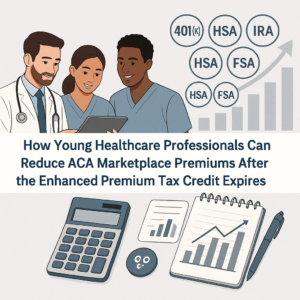
For many physicians and dentists in the early to mid stages of their careers, employer-sponsored benefits are the gold standard. But what happens if you switch jobs, take a sabbatical, pursue private practice, or retire early? The Affordable Care Act (ACA) marketplace becomes a critical backstop – especially the Premium Tax Credit (PTC) that can significantly lower premiums. However, the “enhanced” PTC is set to expire after 2025, meaning any provider with an income above 400% of the Federal Poverty Level (FPL) could face a sudden cost spike in 2026.
In this guide, we’ll explore:
- How the ACA Premium Tax Credit works and why the 400% FPL threshold matters
- Projected cost increases for physicians crossing the subsidy “cliff” in 2026
- Income-management strategies, from retirement contributions to timing bonuses, to stay below key thresholds
- Alternative coverage options like COBRA and healthcare sharing ministries
- Actionable planning steps and how Mainstay Capital can support you
By the end of this article, you’ll have a clear playbook to protect your health coverage affordability, no surprise costs, no guesswork.
1. Understanding the ACA Premium Tax Credit and the 400% FPL Threshold
The Affordable Care Act’s Premium Tax Credit is designed to cap your monthly health plan premium at a percentage of your household income. That cap climbs with income, but only up to 400% of FPL. In 2025, thanks to temporary enhancements under the American Rescue Plan, even higher-income households enjoyed subsidies. After 2025, the old rules return:
- Household income between 100%–400% of FPL: Eligible for a sliding-scale subsidy.
- Income above 400% of FPL: No subsidy – full premium cost.
For a physician couple aged 60, 400% of FPL in 2025 is roughly $80,000. Cross that line by even a single dollar in 2026, and the difference can exceed $20,000 in annual premiums.
This isn’t a smooth phase-out; it’s a cliff. Understanding this cliff is crucial to avoiding an unexpected six-figure medical expense over retirement or career changes.
2. The Financial Impact: Case Study for a 60-Year-Old Physician Couple
Let’s illustrate with a hypothetical but representative example:
- Average salary plus practice income: $80,000 (400% FPL).
- 2025 marketplace premium after PTC: ~$8,000 per year.
- 2026 if income hits $80,001: Full premium ~$30,000 per year.
- Cost increase: ~$22,000 for the same coverage.
For busy physicians planning early retirement or reduced clinical hours, a $22,000 surprise can derail their budget and retirement income projections.
Key takeaway: Effective income planning around the end of 2025 is nonnegotiable if you rely on the ACA marketplace.
3. Income Management Strategies to Maintain Subsidy Eligibility
To avoid the subsidy cliff, the goal is to keep your Modified Adjusted Gross Income (MAGI) at or below 400% of FPL. Here are proven strategies:
3.1 Max Out Tax-Advantaged Retirement Accounts
- 401(k)/403(b) Contributions: Reduce taxable W-2 income. For 2025, the physician catch-up limit is $30,000+ for those over 50.
- SEP-IRA/Solo 401(k): If you run a private practice, consider significant owner contributions.
3.2 Utilize Health Savings Accounts (HSAs)
- Contribute up to $8,300 per family (2025 limit) if enrolled in a high-deductible plan.
- HSA contributions reduce MAGI, and withdrawals for qualified medical expenses are tax-free.
3.3 Defer Bonus and Partnership Distributions
- Request year-end bonuses in January 2026 if your 2025 income is near the threshold.
- Coordinate with partners to delay distribution timing.
3.4 Municipal Bond Interest and Tax-Free Investments
- Coupon payments from municipal bonds are exempt from federal income, keeping MAGI lower.
- Use Roth IRAs for tax-free growth, but remember conversions count toward MAGI.
4. Alternative Coverage Options: COBRA and Healthcare Sharing Ministries
If subsidy planning falls short or you need continuity coverage, evaluate alternatives:
4.1 COBRA Continuation Coverage
- Pros: Keeps the exact same employer plan and network.
- Cons: You pay 102% of the full premium—often 2–3× more than subsidized marketplace options.
4.2 Healthcare Sharing Ministries
- Not insurance, but members share eligible medical expenses.
- Lower monthly “shares” but limited benefits and potential membership eligibility rules.
For many, the marketplace with a reduced subsidy remains the most predictable. But understanding these options can provide peace of mind if you unexpectedly lose subsidies or need gap coverage.
5. Projecting Healthcare Costs into Retirement
Even once you reach Medicare eligibility at 65, premiums and surcharges like IRMAA can hit high earners. Integrate ACA planning with long-term Medicare projections:
- Estimate Part B and Part D IRMAA based on projected MAGI in retirement.
- Factor in Medicare Supplement (Medigap) premiums.
- Model combined out-of-pocket, premium, and IRMAA costs for a complete forecast.
By aligning your income-reduction strategies pre-65, you can minimize both ACA cliffs and IRMAA surcharges after 65. A unified health-coverage plan eliminates surprise expenses and protects your nest egg.
6. How Mainstay Capital Can Help
At Mainstay Capital, we understand that physicians and dentists have unique career paths, income fluctuations, and coverage needs. Our comprehensive services include:
- Personalized Income Modeling – Visualize how contributions, deferrals, and timing affect ACA subsidy eligibility.
- Retirement & Tax Planning – Coordinate retirement account strategies, HSA funding, and municipal bond allocation.
- Ongoing Client Education – Quarterly check-ins to adjust for plan updates, legislative changes, and career transitions.
- Integrated Medicare Forecasting – Ensure smooth transition from ACA to Medicare with minimized IRMAA impact.
Our process starts with a no-obligation consultation to understand your goals, current coverage gaps, and income dynamics. From there, we build a tailored plan that keeps you below critical subsidy cliffs while maximizing long-term retirement security.
7. Action Steps for Physicians Today
As 2025 winds down, take these immediate actions:
- Review your 2024 and projected 2025 MAGI.
- Schedule a call with your financial or tax advisor to explore 401(k)/403(b) and HSA max-out strategies.
- Assess the feasibility of deferring year-end bonuses or partnership draws.
- Run marketplace quotes now and compare against COBRA rates and healthcare sharing ministry “shares.”
- Book a complimentary meeting with Mainstay Capital to model your customized scenario.
Proactive planning now can save you tens of thousands in premiums and keep your focus where it belongs, on patient care and life beyond medicine.