Your Guide to Vesting in Employer Retirement Plans: Maximizing Benefits for Healthcare Professionals
As a physician, dentist, or other healthcare professional, you dedicate years to your career and your patients. While your own 401(k) or IRA contributions are always yours, employer contributions often come with vesting schedules that determine how much you actually take with you if you change jobs. Understanding vesting can add thousands of dollars to your retirement savings over time. In this guide, we’ll break down the key vesting rules, help you spot opportunities to accelerate your benefits, and provide practical tips so you can make informed decisions about your career and financial future.
1. What Is Vesting and Why It Matters
Vesting refers to the percentage of employer-contributed funds in your retirement account that you earn ownership of over time. While your own contributions and their earnings are 100% vested immediately, your employer’s matching or profit-sharing contributions usually follow a schedule. If you aren’t fully vested when you leave, you could forfeit a portion of those funds.
Key Terms
- Vested Percentage: Portion of employer contributions you own.
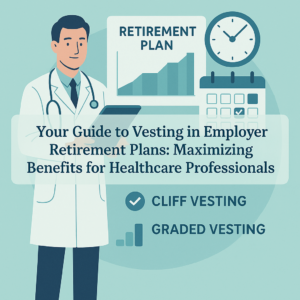
- Cliff Vesting: All or nothing vesting after a set period (e.g., 3 years).
- Graded Vesting: Gradual vesting over multiple years (e.g., 20% per year over 5 years).
Why It Matters for Healthcare Professionals
High student debt, changing roles, or moving to a different hospital system are common in healthcare. Knowing your vesting status:
- Helps you decide whether to stay or negotiate for better benefits.
- Ensures you don’t leave money on the table when you switch jobs.
- Guides your retirement planning strategy.
2. Types of Vesting Schedules
There are two main vesting approaches used by employer-sponsored plans:
Cliff Vesting
- Employees become 100% vested after a specified period (often 3 years for 401(k) plans or 5 years for defined benefit plans).
- Before the cliff date, vested percentage is 0%.
Example: You join a hospital in January 2021 with a 3-year cliff vesting schedule. If you leave before January 2024, you receive none of the employer match; leave after, you get 100%.
Graded Vesting
- Vesting increases gradually, such as 20% vested after 2 years, 40% after 3 years, up to 100% by year 6.
- Common in both defined contribution and defined benefit plans.
Example: A 6-year graded schedule might vest you at 20% after two years, 40% after three, and so on, reaching 100% at year six.
3. Vesting Rules for Defined Contribution Plans (e.g., 401(k))
In defined contribution plans, such as a 401(k), your own salary deferrals are always 100% vested. However, employer match contributions typically follow a vesting schedule.
Legal Minimums
- Cliff vesting: Plan must fully vest by year 3 at latest.
- Graded vesting: Must vest at least 20% by year 2 and 100% by year 6.
Maximizing Your 401(k) Vesting
- Track your vesting date in your plan’s summary plan description (SPD).
- Consider staying just until your next vesting milestone if a job change is on the horizon.
- Negotiate accelerated vesting if you move to a partner track or administrative role.
4. Vesting Rules for Defined Benefit Plans
Defined benefit (DB) plans promise a specific monthly benefit at retirement, calculated via a formula. Vesting schedules in DB plans are often more stringent.
Typical Vesting Schedule
- 5-year cliff vesting is common—no vesting until you complete five years of service.
- Some plans may offer graded vesting in rare cases.
Special Provisions
- Full vesting at normal retirement age regardless of years of service.
- Immediate vesting in case of plan termination, disability, or death.
5. Vesting and IRAs: A Different Story
Unlike employer-sponsored plans, Individual Retirement Arrangements (IRAs) — including SEP-IRAs and SIMPLE IRAs — do not impose vesting rules. You always own 100% of the balance in your IRA.
Why IRAs Are Straightforward
- Contributions, rollovers, and earnings in IRAs belong to you immediately.
- No employer match or profit-sharing component to track.
When to Use an IRA vs. Employer Plan
- If you want full control and immediate ownership, prioritize IRAs.
- Combine IRA contributions with your 401(k) match to maximize retirement savings.
6. Tips to Maximize Your Vesting Benefits
- Monitor Service Hours: Many plans require 1,000 hours per year for vesting credit—track your total hours.
- Plan Career Moves: Align job changes with vesting milestones to avoid forfeiting employer match.
- Negotiate Vesting: If you’re a high-value hire (e.g., specialist physician), ask for accelerated vesting.
- Use Breaks Strategically: If you anticipate a sabbatical or maternity leave, confirm how vesting service is calculated during unpaid leaves.
- Stay Informed: Review your SPD annually—rules can change, and employer contributions may vary.
7. Common Mistakes to Avoid
- Assuming you’re vested automatically—always verify your schedule.
- Overlooking plan termination clauses—if your employer ends the plan, you may vest immediately.
- Neglecting rollovers—if you leave before full vesting, roll over your vested portion promptly to avoid taxes and penalties.
- Ignoring combined service rules—some multi-location health systems allow service credit across affiliates.
8. Next Steps and Resources
For personalized guidance on how vesting rules fit into your overall retirement strategy, consider:
- Consulting with a fee-only advisor to model different career scenarios.
- Visiting our Services page to see how we help healthcare professionals plan for retirement.
- Learning about our approach on the Our Process page, where we outline step-by-step planning tailored to your career milestones.
- Exploring our About Us page to understand our commitment to unbiased, conflict-free advice.
Remember: This guide provides general information. It does not constitute investment advice. For advice tailored to your situation, please reach out to a qualified financial professional.
9. Conclusion
Vesting rules can significantly impact the retirement benefits you actually receive from employer-sponsored plans. As a busy healthcare professional, a clear vesting strategy ensures you capture every dollar your employer contributes. Track your vesting schedule, plan job transitions wisely, and leverage IRAs to supplement your savings. With the right approach, you’ll maximize the value of your benefits and build a more secure retirement. Ready to take control? Visit our homepage to get started today.